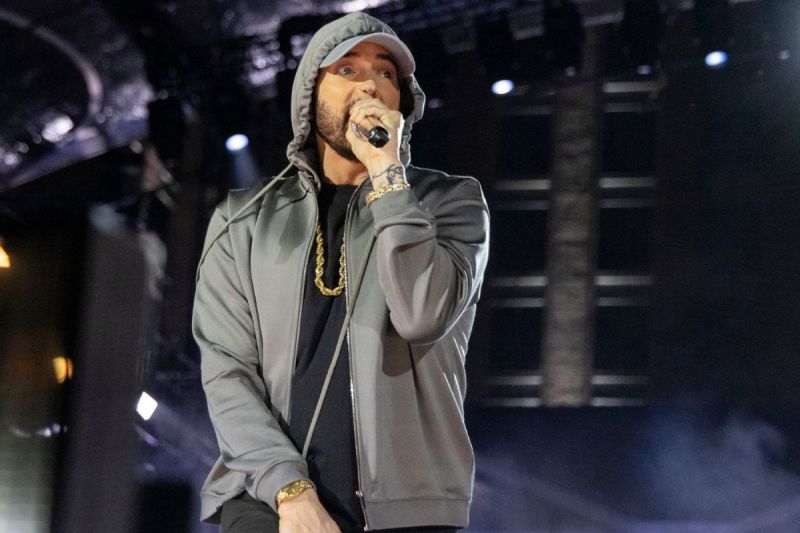
Nearly 20 years after his near-fatal drug overdose, Eminem celebrates a new sobriety milestone.
Videos by Suggest
In his most recent Instagram post, the famed rapper shared a photo of his latest sobriety chip. “To thine own self be true,” the chip reads. It also says “unity, service, recovery” with the number 18 in Roman numerals.
“XVIII,” Eminem wrote in the post’s caption with a medal emoji.
The “Without Me” hitmaker previously struggled with a prescription medication and alcohol addiction. He first went to rehab in 2005. However, things took a turn when an acquaintance gave him unidentified blue pills, which were later found to be methadone.
He woke up in a hospital after a near-fatal overdose.
“My doctor told me the amount of methadone I’d taken was equivalent to shooting up four bags of heroin,” Eminem explained during a 2009 interview with VIBE. “I probably wouldn’t have taken it. But as bad as I was back then, I can’t even say 100 percent for sure.”
Eminem Reflected on His Sobriety Journey in the 2025 Documentary ‘STANS’
The rapper got candid about his sobriety in the 2025 documentary STANS.
“After the overdose, I came home going, ‘Yo, bro, I need something,'” he recalled. “‘I’m going to die if I don’t do something.'”
Speaking about the overdose, Eminem said he didn’t remember anything.
“I didn’t know what the f— happened,” he admitted. “It seemed like I fell asleep, and I woke up with tubes in me and s—. I wanted to get up. I couldn’t move.”
During a 2022 appearance on the podcast Paul Rosenberg’s Paul Pod, Eminem chatted about how he felt after starting his recovery.
“I remember when I first got sober and all the s— was out of my system, I remember just being, like, really happy and everything was f—ing new to me again,” he noted.
Amid the early years of his sobriety, Eminem released his album Relapse.
“It was the first album and the first time that I had fun recording in a long time,” he pointed out.
If you or someone you know is struggling with substance abuse or addiction, please call SAMHSA’s National Helpline at 1-800-662-HELP (4357). SAMHSA’s National Helpline is free, confidential and available 24/7.