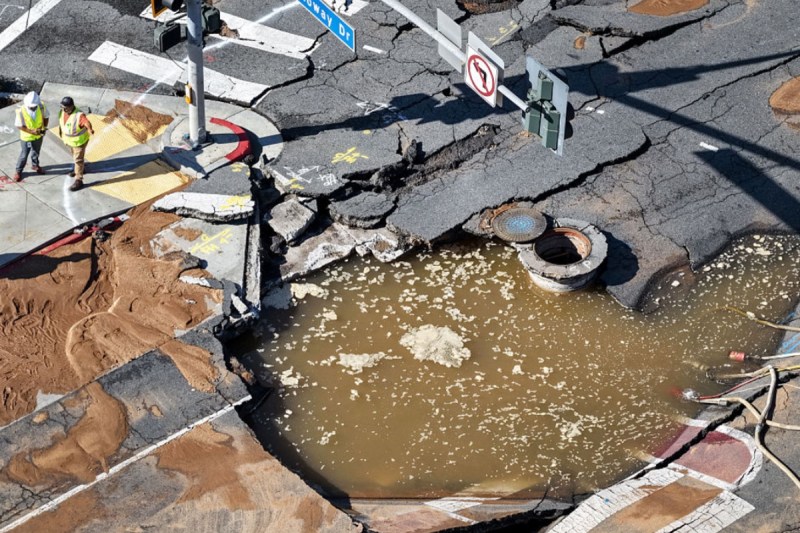
Thursday morning, a water main in West Hollywood burst open, turning streets into impromptu rivers, swallowing cars, damaging property, and opening up a massive sinkhole.
Videos by Suggest
The break was reported at approximately 3 a.m. near the intersection of Holloway Drive and Sunset Boulevard, per local outlet KTLA.
“It’s a rupture of one of the significant mains that goes through here. West Hollywood, as it turns out, is an area where mains from a number of different water companies cross,” Los Angeles County Fire Department Capt. Aaron Katon told the outlet.
The rupture opened a massive sinkhole at the intersection of Sunset Boulevard and Holloway Drive. The area, typically busy with businesses and restaurants, was forced to shut down as heavy equipment moved in for repairs.
Harrowing footage shows the giant sinkhole that opened up after the 100-year-old water main burst.
#BreakingNews: Sunset Boulevard is closed indefinitely in West Hollywood after a massive, 100-year-old water main ruptured early Thursday morning, creating a large sinkhole directly under the traffic light at Sunset Boulevard and Holloway Drive. pic.twitter.com/yieGkrTQII
— KTLA (@KTLA) July 16, 2026
Around 7 a.m., two men fell into a sinkhole that opened up on Palm Avenue near Sunset Boulevard. Both appeared to be unharmed following the incident, according to KTLA.
Crews shut off water to the pipe at around 7 a.m.
A Water Main Dating Back to 1916 Ruptured, Officials Say
The Los Angeles Department of Water and Power identified the ruptured pipe as a 36-inch trunk line dating back to 1916. Meanwhile, the damaged main has been isolated. A nearby 8-inch distribution line has kept water flowing to almost all customers in the area, with just one customer experiencing a temporary loss of service, officials said.
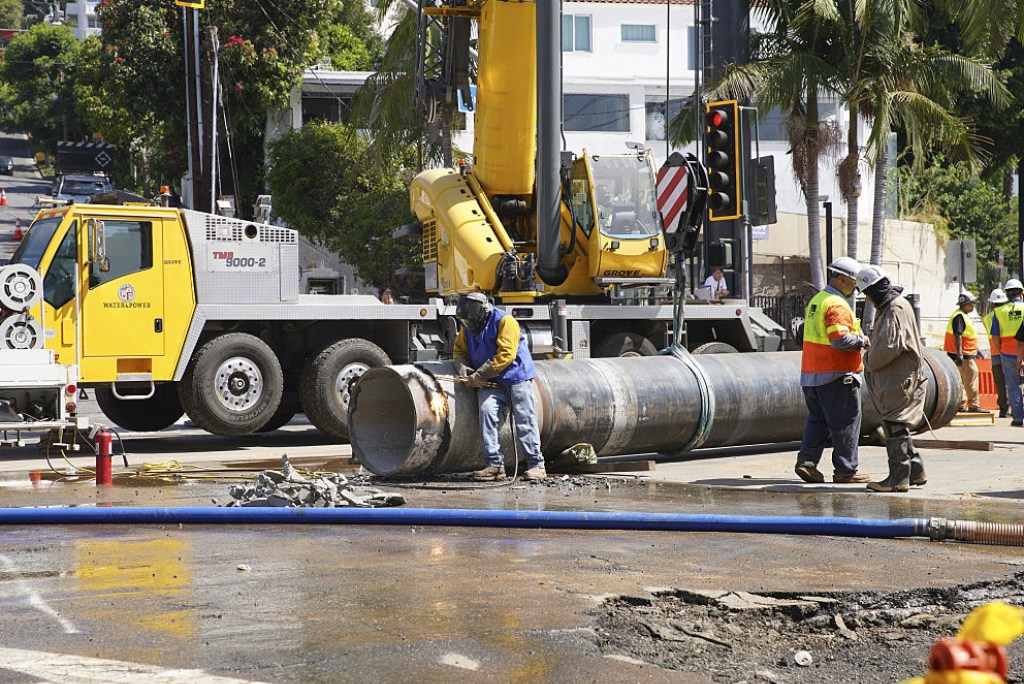
The cause of the rupture is still under investigation. Meanwhile, LADWP Chief Operating Officer Anselmo Collins explained that water main breaks often happen overnight. This is because water pressure peaks when demand is low. Furthermore, he noted that the utility replaces around 45 miles of pipe annually across its 7,400-mile system.
The repairs could take anywhere from a few days to several weeks.