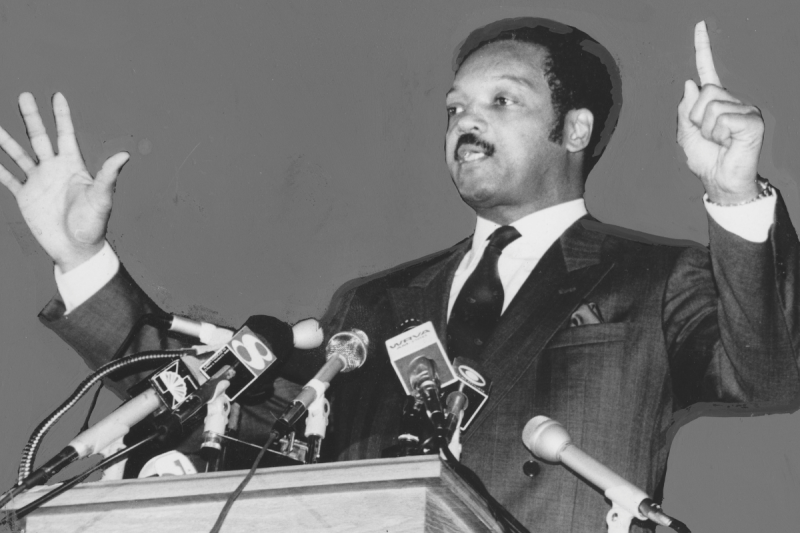
Legendary civil rights activist Jesse Jackson has been hospitalized in Chicago amid numerous health issues.
Videos by Suggest
Sources close to the situation told local media outlet ABC7 Chicago that Jackson is at Northwestern Memorial Hospital for his treatment.
In a statement from Rainbow PUSH Coalition, which Jackson founded, it was revealed that the civil rights activist is “under observation for Progressive Supranuclear Palsy (PSP), a neurodegenerative disorder he has managed for more than a decade.”
“Jackson, who was initially diagnosed with Parkinson’s disease, received confirmation of his PSP diagnosis in April,” the organization shared. “His family asks for continued prayers during this time.”
According to the Mayo Clinic, Progressive Supranuclear Palsy (PSP) is a rare brain disease that affects walking, balance, eye movements, and swallowing. The condition results from damage to cells in areas of the brain that control body movement, coordination, thinking, and other important functions.
“Progressive supranuclear palsy worsens over time and can lead to dangerous complications,” the Mayo Clinic points out. “Such as pneumonia and trouble swallowing. There’s no cure for progressive supranuclear palsy, so treatment focuses on managing the symptoms.”
Jesse Jackson was known in the 1960s as Dr. Martin Lurth King Jr.’s protégé. The 84-year-old spent decades advocating for racial equality and economic justice. He previously ran for president in the 1984 and 1988 elections.
Jackson spent three decades leading Rainbow PUSH Coalition before officially stepping down in 2023.
Jesse Jackson Previously Opened up About His Parkinson’s Disease Diagnosis
In a 2017 statement to CNN, Jesse Jackson opened up about first discovering he had Parkinson’s disease.
“My family and I began to notice changes about three years ago,” he explained. “After a battery of tests, my physicians identified the issue as Parkinson’s disease, a disease that bested my father.”
Jackson further shared that “recognition of the effects of this disease” on him has been “painful.”
The civil rights activist also said that he saw his Parkinson’s diagnosis as “a signal” that he had to make some lifestyle changes. He also wanted to dedicate himself to physical therapy in “hopes of slowing the disease progression.”